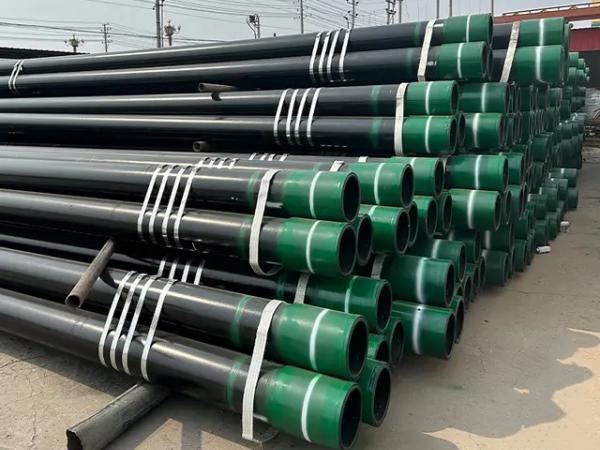
API 5CT J55 casing pipe is a medium-strength carbon steel pipe defined under the API 5CT standard, mainly used in shallow to medium-depth oil and gas wells. It offers a balance of cost efficiency, adequate strength, and reliable performance in low-pressure and non-corrosive environments.
API 5CT is a specification developed by the American Petroleum Institute (API) that defines the technical requirements for casing and tubing used in oil and gas wells, including:
Material grades
Mechanical properties
Heat treatment
Dimensions and tolerances
Inspection and testing
It ensures consistency, safety, and interchangeability in global oilfield operations.
Yield Strength: 379 – 552 MPa
Tensile Strength: ≥ 517 MPa
Elongation: ≥ 19%
Hardness: Within API limits
Impact Testing: Required under PSL conditions
Engineering Insight: J55 provides sufficient strength for standard well conditions but is not designed for high-stress or high-pressure environments.
J55 is a carbon-manganese steel with controlled elements to ensure weldability and strength:
Carbon (C): Moderate level for strength
Manganese (Mn): Improves toughness
Sulfur (S) & Phosphorus (P): Strictly limited
Key Point: Composition is optimized for manufacturability and cost control rather than extreme performance.
API 5CT J55 casing is available in a wide range of sizes:
Outer Diameter: Typically 4 1/2" to 20"
Wall Thickness: According to API schedules
Length: R1, R2, R3 (standard casing lengths)
Benefit: Flexible sizing supports different well designs.
|
Code a |
Outer Diameter |
Nominal Weight |
Wall Thickness |
End Processing Type |
|
|
(with thread and coupling) b, c |
|||||
|
mm |
kg/m |
mm |
J55 |
||
|
Inch |
Lb/ft |
K55 |
|||
|
1 |
2 |
3 |
4 |
5 |
7 |
|
9 5/8 |
32.3 |
244.48 |
48.07 |
7.92 |
– |
|
9 5/8 |
36 |
244.48 |
53.57 |
8.94 |
SLB |
|
9 5/8 |
40 |
244.48 |
59.53 |
10.03 |
SLB |
|
9 5/8 |
43.5 |
244.48 |
64.73 |
11.05 |
– |
|
9 5/8 |
47 |
244.48 |
69.94 |
11.99 |
– |
|
9 5/8 |
53.5 |
244.48 |
79.62 |
13.84 |
– |
|
9 5/8 |
58.4 |
244.48 |
86.91 |
15.11 |
– |
|
10 3/4 |
32.75 |
273.05 |
48.74 |
7.09 |
– |
|
10 3/4 |
40.5 |
273.05 |
60.27 |
8.89 |
SB |
|
10 3/4 |
45.5 |
273.05 |
67.71 |
10.16 |
SB |
|
10 3/4 |
51 |
273.05 |
75.9 |
11.43 |
SB |
|
10 3/4 |
55.5 |
273.05 |
82.59 |
12.57 |
– |
|
10 3/4 |
60.7 |
273.05 |
90.33 |
13.84 |
– |
|
10 3/4 |
65.7 |
273.05 |
97.77 |
15.11 |
– |
|
11 3/4 |
42 |
298.45 |
62.5 |
8.46 |
– |
|
11 3/4 |
47 |
298.45 |
69.94 |
9.53 |
SB |
|
11 3/4 |
54 |
298.45 |
80.36 |
11.05 |
SB |
|
11 3/4 |
60 |
298.45 |
89.29 |
12.42 |
SB |
|
13 3/8 |
48 |
339.72 |
71.43 |
8.38 |
– |
|
13 3/8 |
54.5 |
339.72 |
81.1 |
9.65 |
SB |
|
13 3/8 |
61 |
339.72 |
90.78 |
10.92 |
SB |
|
13 3/8 |
68 |
339.72 |
101.19 |
12.19 |
SB |
|
13 3/8 |
72 |
339.72 |
107.15 |
13.06 |
– |
|
16 |
65 |
406.4 |
96.73 |
9.53 |
– |
|
16 |
75 |
406.4 |
111.61 |
11.13 |
SB |
|
16 |
84 |
406.4 |
125.01 |
12.57 |
SB |
|
18 5/8 |
87.5 |
473.08 |
130.21 |
11.05 |
SB |
|
20 |
94 |
508 |
139.89 |
11.13 |
SLB |
|
20 |
106.5 |
508 |
158.49 |
12.7 |
SLB |
|
20 |
133 |
508 |
197.93 |
16.13 |
SLB |
|
S-Short round thread, L-Long round thread, B-Buttress thread |
|||||
|
a. Code is used for ordering reference. |
|||||
|
b. The nominal weight of threaded and coupled casing (column 2) is shown for reference only. |
|||||
Typical Applications
Shallow oil and gas wells
Water well drilling
Geothermal wells
Geological exploration
Low-pressure reservoirs
Suitable Conditions
Stable formations
Low pressure
Low corrosion environments
Not Recommended For:
Deep wells
High-pressure / high-temperature (HPHT) conditions
Sour service (H₂S environments)
Advantages:
Cost-effective compared to higher grades (e.g., N80, P110)
Widely available globally
Reliable for standard drilling operations
Easy to process and manufacture
Limitations:
Lower strength than higher-grade casing
Limited corrosion resistance
Not suitable for complex well conditions
Q1: What does J55 mean in API 5CT?
J55 refers to a steel grade with a minimum yield strength of 55,000 psi under the API 5CT standard.
Q2: Is J55 casing suitable for deep wells?
No, J55 is mainly used for shallow to medium-depth wells due to its moderate strength.
Q3: What is the difference between J55 and N80?
N80 has higher strength and better resistance to pressure, making it suitable for deeper and more demanding wells.
Q4: Can J55 be used in corrosive environments?
Generally not recommended unless additional anti-corrosion measures are applied.
API 5CT J55 casing pipe is a cost-effective and widely used solution for standard oil and gas drilling operations. With stable mechanical properties and broad availability, it is best suited for shallow wells, low-pressure reservoirs, and non-corrosive environments.

United Steel Industry As the most important steel pipe manufacturer and exporter in China, in the past 20 years, we have completed more than 100 projects, with partners in more than 100 countries, and established relationships with oil and gas and EPC companies in many countries business relationship.
For more information about the product price, catalog and rolling mill inspection certificate,
please consult:Email:Sales@usisteels.com