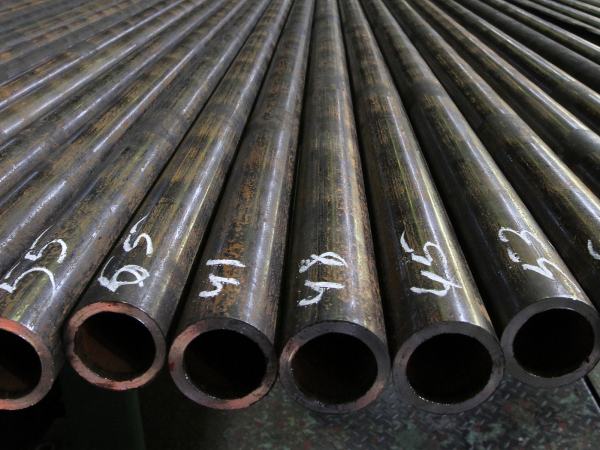
Seamless mechanical tubing refers to steel tubes manufactured without a welded seam, delivering:
High tensile strength
Uniform microstructure
Excellent dimensional accuracy
Superior resistance to pressure and stress
Unlike standard fluid pipes, seamless mechanical tubing is primarily used in:
Precision machining components
Structural applications
Heavy-duty equipment manufacturing
Its seamless structure eliminates weld-related weak points, making it ideal for high-reliability engineering scenarios.
Core Manufacturing Process
Seamless mechanical tubing is produced through the following steps:
Solid steel billet heating
Rotary piercing to create a hollow shell
Hot rolling or cold drawing for sizing and finishing
This process ensures:
No weld defects
Consistent wall thickness
Enhanced mechanical properties
Two primary production methods dominate the market:
Produced directly after hot rolling
Lower production cost
Suitable for structural applications with standard tolerances
Additional cold drawing over mandrel
Improved dimensional precision
Enhanced surface finish and hardness
|
Feature |
Hot Finished Seamless (HFS) |
Cold Drawn Seamless (CDS) |
|
Surface Quality |
Rough, oxide scale |
Smooth, bright |
|
Tolerance |
Standard |
Tight precision |
|
Cost |
Lower |
Higher |
|
Strength |
High |
Higher (work hardened) |
|
Machinability |
Good |
Excellent |
Selection Insight:
Use HFS for structural strength with cost efficiency
Use CDS for precision machining and tight tolerances
Seamless mechanical tubing is critical in industries where strength, safety, and reliability are non-negotiable:
Key Application Sectors
Automotive Manufacturing
Transmission components
Axles and shafts
Construction & Heavy Equipment
Crane booms
Bulldozer structures
Scaffolding systems
Oil & Gas Equipment
High-pressure mechanical components
Hydraulic Systems
Hydraulic cylinders
Pressure-bearing assemblies
|
Grade |
Typical Use |
Key Advantage |
|
AISI 1018 |
General machining |
Good machinability |
|
AISI 1026 |
Structural components |
Higher strength |
|
AISI 4140 |
Gears, shafts |
Heat-treatable, high toughness |
|
ST52 |
Hydraulic cylinders |
High yield strength |
Material selection directly impacts durability, fatigue resistance, and lifecycle cost.
Selecting the right supplier is essential for quality assurance and project timelines.
Key Evaluation Criteria
ISO 9001 (Quality Management)
ISO 14001 (Environmental Management)
CE compliance
Hydrostatic testing
Eddy current inspection
Mechanical property verification
Wide size range availability
Stable production capacity
Short lead times
Cutting and machining
End finishing (beveling)
Export packaging and logistics
5. Third-Party Inspection
SGS
BV
TÜV
|
Criteria |
Importance |
Key Indicator |
|
Certifications |
Process reliability |
ISO / CE |
|
Testing |
Material safety |
Full inspection reports |
|
Inventory |
Delivery speed |
Stock availability |
|
Logistics |
Risk reduction |
Export experience |
Seamless mechanical tubing provides:
Higher structural integrity
Improved fatigue resistance
Better machining performance
Reduced failure risk in critical applications
These advantages make it indispensable in modern engineering and manufacturing.
Seamless mechanical tubing is a core material for high-performance applications requiring strength, precision, and reliability. Understanding manufacturing methods, material grades, and supplier capabilities ensures optimal procurement decisions.
United Steel Industry offers:
High-quality seamless mechanical tubing
Full specification compliance (ASTM, EN standards)
Integrated processing and global delivery
For projects requiring both mechanical tubing and fluid transport pipes, a one-stop supply approach improves efficiency and reduces sourcing complexity.
Q1: What is the difference between seamless and welded mechanical tubing?
Seamless tubing has no weld seam, offering higher strength and uniformity, while welded tubing may have structural weak points at the seam.
Q2: When should CDS be preferred over HFS?
CDS is preferred when tight tolerances, smooth surface finish, and precision machining are required.
Q3: What standards apply to seamless mechanical tubing?
Common standards include ASTM A519, EN 10297, and DIN specifications.
Q4: What is the main advantage of seamless tubing in heavy equipment?
Its ability to withstand high stress and pressure without failure.

United Steel Industry As the most important steel pipe manufacturer and exporter in China, in the past 20 years, we have completed more than 100 projects, with partners in more than 100 countries, and established relationships with oil and gas and EPC companies in many countries business relationship.
For more information about the product price, catalog and rolling mill inspection certificate,
please consult:Email:Sales@usisteels.com