In civil engineering, steel pipe piles are deep foundation elements used to transfer structural loads safely into competent soil or bedrock layers. They are essential for stabilizing high-rise buildings, bridges, offshore platforms, and heavy industrial structures.
With global infrastructure expansion accelerating, the steel pipe pile market is expected to continue growing steadily toward multi-billion-dollar scale by the late 2020s, driven by demand for high-capacity, reliable foundation systems in complex geotechnical conditions.
This article explains how steel pipe piles work, including load transfer mechanisms, installation methods, and engineering applications.
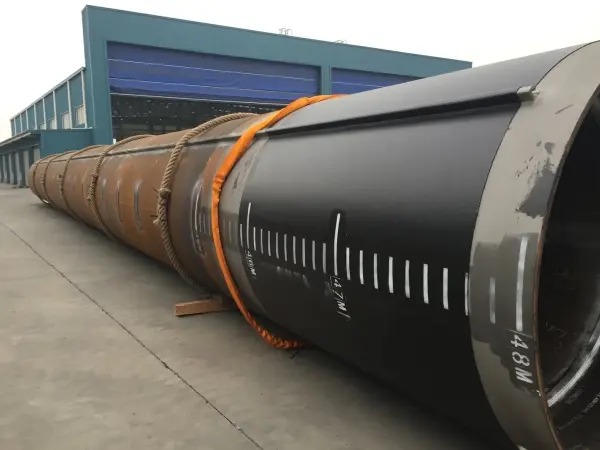
A steel pipe pile is a cylindrical steel structural element driven or installed into the ground to carry axial and lateral loads.
Core Components
High-strength steel pipe shell (commonly ASTM A252 Grade 2/3)
Protective anti-corrosion coatings (epoxy, galvanizing, 3PE, etc.)
Driving shoe for soil penetration efficiency
Welded or threaded joints for extension
Optional concrete infill for composite behavior
Steel pipe piles are defined by structural and geotechnical design parameters:
Diameter: ~300 mm to 3000 mm
Wall thickness: ~6 mm to 50 mm
Length: up to 90 m per segment (longer via splicing)
Load capacity: typically 50–1000+ tons per pile depending on soil and design
These parameters are selected based on geotechnical investigation and structural load requirements.
Steel pipe piles resist structural loads through a combination of geotechnical and structural interactions.
Load is transferred directly to a hard soil layer or rock at the pile tip.
Typically carries 60–80% of total load
Effective in dense sand, gravel, or bedrock
Performance depends on bearing stratum strength and pile tip area
Load is transferred along the interface between pile surface and surrounding soil.
Dominant in soft or cohesive soils
Accumulates along embedded length
Critical when end-bearing is weak or absent
When filled with concrete, steel pipe piles form a composite system:
Steel resists bending and tension
Concrete enhances axial compression capacity
Improves stiffness and buckling resistance significantly
Advanced foundation design considers dynamic soil effects:
Soil plugging during driving increases resistance
Setup effect: capacity increases over time after installation
Negative skin friction may occur in consolidating soils
Group pile effects influence efficiency in clustered systems
Uses diesel or hydraulic hammers
High-energy impacts drive pile into soil
Fast and cost-effective
Requires driving analysis for quality control
High-frequency vibration reduces soil resistance
Suitable for loose sand and soft soils
Limited effectiveness in dense or clay soils
Borehole is drilled first
Steel pipe pile inserted
Annular space filled with grout or concrete
Ideal for complex geology or urban zones
Static pressing method using hydraulic force
Low vibration and noise
Suitable for sensitive urban environments
High load-bearing capacity
Excellent performance in deep foundations
Adaptable to diverse soil conditions
High structural stiffness
Long service life with proper corrosion protection
Suitable for offshore and seismic environments
Steel pipe piles are widely used in:
High-rise building foundations
Bridge piers and abutments
Offshore wind and marine structures
Port and harbor infrastructure
Heavy industrial facilities
Seismic reinforcement systems
Long-term performance depends heavily on corrosion control:
Epoxy and 3PE coatings
Cathodic protection systems
Galvanization for moderate environments
Designed service life: 50–100+ years
Common inspection methods include:
Pile Integrity Testing (PIT)
Crosshole Sonic Logging (CSL)
Dynamic load testing (PDA)
Settlement monitoring systems
These ensure structural safety and design compliance.
Steel pipe piles work by combining end-bearing resistance, skin friction, and structural integrity to safely transfer loads into deep ground layers. Their adaptability, strength, and durability make them one of the most reliable foundation systems in modern engineering.
For optimal performance, successful application depends on:
Accurate geotechnical investigation
Proper pile selection and sizing
Correct installation method
Effective corrosion protection strategy
Q1: What is the main function of steel pipe piles?
They transfer structural loads from buildings or infrastructure into deep, stable soil or rock layers.
Q2: How do steel pipe piles carry load?
Through a combination of end-bearing resistance at the tip and skin friction along the pile shaft.
Q3: Where are steel pipe piles commonly used?
They are widely used in bridges, skyscrapers, marine structures, and heavy industrial foundations.
Q4: What affects steel pipe pile capacity?
Soil conditions, pile diameter, installation method, and material strength.

United Steel Industry As the most important steel pipe manufacturer and exporter in China, in the past 20 years, we have completed more than 100 projects, with partners in more than 100 countries, and established relationships with oil and gas and EPC companies in many countries business relationship.
For more information about the product price, catalog and rolling mill inspection certificate,
please consult:Email:Sales@usisteels.com