To improve the stability of large diameter spiral welded steel pipe (SSAW pipe), manufacturers must control heat treatment processes, reduce residual stress, optimize cooling methods, and protect stress-sensitive areas. The goal is to prevent cracking, deformation, and performance degradation.
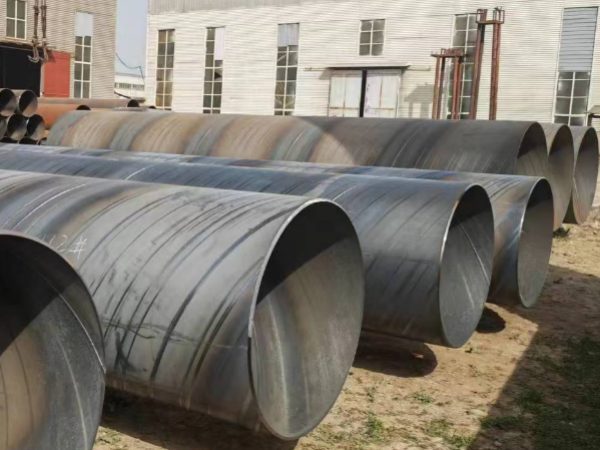
Large diameter spiral welded steel pipes are widely used in:
Oil and gas transmission
Water supply systems
Structural engineering
Key Challenge:
Due to large size and welding + heat treatment processes, pipes are prone to:
Residual stress accumulation
Quenching cracks (including delayed “aging cracks”)
Deformation during cooling
After quenching, pipes contain high internal stress that may lead to delayed cracking.
Solution:
Perform tempering immediately after quenching
Release residual stress
Prevent “aging cracks”
For crack-sensitive steel grades:
Method:
Use residual heat from quenching for controlled self-tempering
Allow gradual stress redistribution
Benefit:
Reduces thermal shock and improves structural stability.
For alloy steels (low thermal conductivity):
Best Practices:
Use lower quenching temperatures
Reduce holding time
Apply multi-stage preheating
Result:
More uniform temperature distribution
Reduced internal stress and distortion
Weak sections are more prone to cracking, such as:
Sharp corners
Grooves
Threaded or machined areas
Protection Measures:
Wrap with heat-resistant materials (e.g., insulation or metal shielding)
Use local pre-cooling or controlled cooling
Goal:
Reduce stress concentration and slow local cooling rates.
Cooling rate directly determines crack risk.
Options:
Oil cooling: Preferred (slower, more uniform cooling)
Water cooling: Faster but higher crack risk
Salt solutions: Suitable for complex geometries (controlled cooling)
Key Control:
Precise cooling time
Timely removal from cooling medium
Large diameter SSAW pipes are more sensitive to temperature gradients
Weld zones and heat-affected zones (HAZ) are critical crack initiation points
Process consistency is essential for batch stability
Q1: What causes cracks in SSAW pipes?
Mainly residual stress, rapid cooling, and uneven temperature distribution.
Q2: What is “aging cracking”?
Delayed cracking that appears after quenching due to internal stress.
Q3: Which cooling method is safest?
Oil cooling is generally safer than water cooling due to reduced thermal shock.
Q4: Why is preheating necessary?
It reduces thermal gradients and prevents stress concentration during quenching.

United Steel Industry As the most important steel pipe manufacturer and exporter in China, in the past 20 years, we have completed more than 100 projects, with partners in more than 100 countries, and established relationships with oil and gas and EPC companies in many countries business relationship.
For more information about the product price, catalog and rolling mill inspection certificate,
please consult:Email:Sales@usisteels.com