ERW, LSAW, and SSAW are the three most common welded steel pipe manufacturing methods. Although all are welded pipes, they differ significantly in welding process, diameter range, mechanical performance, manufacturing cost, and typical applications.
ERW (Electric Resistance Welded) pipes use high-frequency electrical resistance welding without filler metal.
LSAW (Longitudinal Submerged Arc Welded) pipes are produced from steel plates with double-sided submerged arc welding.
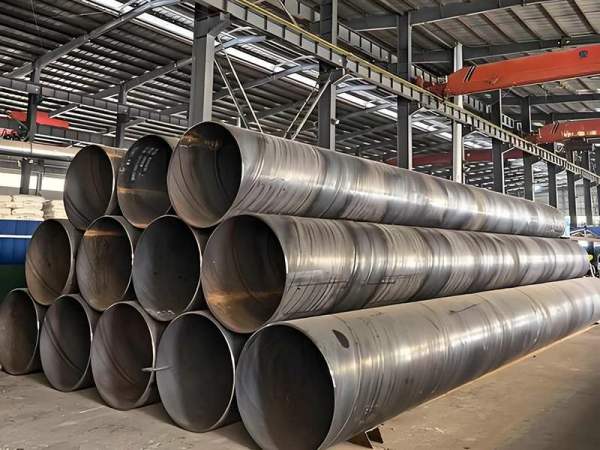
SSAW (Spiral Submerged Arc Welded) pipes are formed by spiral rolling steel coils followed by submerged arc welding.
Selecting the appropriate welded pipe depends on project pressure, pipe diameter, installation environment, and applicable design standards.
|
Comparison Item |
ERW |
LSAW |
SSAW |
|
Weld Type |
Straight seam, high-frequency resistance weld |
Straight seam, double-sided submerged arc weld |
Spiral submerged arc weld |
|
Raw Material |
Hot-rolled steel coil |
Steel plate |
Steel coil |
|
Diameter Range |
Up to 24 in. (610 mm) |
Approximately 16–60 in. and larger |
Up to 120 in. (3048 mm) or larger |
|
Wall Thickness |
Mainly ≤25 mm |
Can exceed 100 mm |
Usually ≤25 mm |
|
Dimensional Accuracy |
Excellent |
Very Good |
Good |
|
Weld Inspection |
UT/ECT commonly used |
100% RT/UT available |
RT/UT available |
|
Manufacturing Cost |
Lowest |
Highest |
Moderate |
|
Typical Applications |
Water, gas, structural |
Oil & gas transmission, offshore pipelines |
Water transmission, piling, low-pressure pipelines |
ERW pipe is manufactured by continuously forming hot-rolled steel strip and joining the edges through high-frequency electric resistance welding. Since no filler metal is added, production efficiency is high and manufacturing costs remain relatively low.
Advantages
Lowest production cost
Excellent dimensional accuracy
Uniform wall thickness
Smooth internal and external surfaces
High production efficiency
Easy installation and welding
Limitations
Limited diameter range (generally up to 24 inches)
Not ideal for extremely thick-wall applications
Weld quality depends heavily on manufacturing control and non-destructive testing
Typical Applications
ERW pipe is commonly selected for:
Natural gas distribution
Water supply pipelines
Fire protection systems
Structural steel applications
Mechanical tubing
Municipal engineering
For most medium- and low-pressure systems, ERW provides the best balance between performance and cost.
LSAW pipe is produced by forming steel plate into a cylindrical shape and performing double-sided submerged arc welding. The manufacturing process delivers excellent weld quality and outstanding mechanical performance.
Advantages
High structural reliability
Excellent pressure resistance
Thick-wall capability
High dimensional stability
Suitable for 100% radiographic inspection (RT)
Limitations
Higher manufacturing cost
Lower production efficiency
Greater material consumption than ERW or SSAW
Typical Applications
LSAW pipes are widely used in:
Long-distance oil pipelines
Natural gas transmission lines
Offshore pipelines
High-pressure pipeline systems
Power generation projects
Petrochemical facilities
For critical infrastructure where safety and reliability are the highest priorities, LSAW is often the preferred solution.
SSAW pipe is manufactured by spirally forming steel coil before submerged arc welding. This process allows manufacturers to produce a wide range of large diameters using the same coil width.
Advantages
Large diameter capability
Efficient material utilization
Lower manufacturing cost than LSAW
Flexible production for various pipe sizes
Limitations
Longer weld length than straight seam pipes
Lower dimensional precision
Higher probability of weld-related defects if quality control is inadequate
Not recommended for certain high-pressure transmission systems
Typical Applications
SSAW pipe is commonly used for:
Water transmission pipelines
Low-pressure gas pipelines
Steel pipe piles
Bridge foundations
Structural support systems
Irrigation projects
For large-diameter, medium- or low-pressure applications, SSAW offers excellent economic value.
Pipe selection should consider several engineering factors:
Pipe Diameter
Up to 24 inches → ERW is usually the most economical option.
Large diameters above 24 inches → SSAW or LSAW are generally preferred.
Operating Pressure
Medium and low pressure → ERW or SSAW
High pressure → LSAW
Project Environment
Critical infrastructure such as:
Oil and gas trunk pipelines
Offshore projects
High-pressure transmission systems
typically favors LSAW because of its superior weld integrity and inspection capability.
For municipal water supply, structural engineering, and piling projects, ERW or SSAW often provide a more cost-effective solution.
There is no universally "best" welded steel pipe. The optimal choice depends on engineering requirements.
|
Project Requirement |
Recommended Pipe |
|
Lowest cost |
ERW |
|
Highest quality and pressure resistance |
LSAW |
|
Large diameter with budget control |
SSAW |
|
Municipal water pipelines |
ERW / SSAW |
|
Oil & gas transmission |
LSAW |
|
Structural engineering |
ERW |
|
Pipe piling |
SSAW |
Selecting the right manufacturing process helps improve project reliability while optimizing procurement costs.
1. What is the main difference between ERW, LSAW, and SSAW pipes?
The primary difference is the welding method. ERW uses electric resistance welding, LSAW uses longitudinal submerged arc welding, and SSAW uses spiral submerged arc welding.
2. Which welded pipe has the highest pressure resistance?
LSAW pipe generally offers the highest pressure-bearing capability because of its thick-wall construction and high-quality double-sided submerged arc weld.
3. Is ERW pipe suitable for oil and gas applications?
Yes. ERW pipe is widely used for medium- and low-pressure oil, gas, and water transmission systems, provided it meets the applicable API or ASTM standards.
4. When should SSAW pipe be selected?
SSAW pipe is ideal for large-diameter, medium- or low-pressure applications such as water transmission, piling, irrigation, and structural projects where cost efficiency is important.

United Steel Industry As the most important steel pipe manufacturer and exporter in China, in the past 20 years, we have completed more than 100 projects, with partners in more than 100 countries, and established relationships with oil and gas and EPC companies in many countries business relationship.
For more information about the product price, catalog and rolling mill inspection certificate,
please consult:Email:Sales@usisteels.com