The thickness of a seamless steel pipe is a critical engineering parameter that directly influences pressure resistance, structural strength, weight, cost, and application suitability. In demanding industries such as oil and gas, boilers, power generation, chemicals, and machinery manufacturing, seamless pipes are widely preferred due to their weld-free structure, high density, and stable performance.
Among all dimensional parameters, wall thickness plays a decisive role in both design calculations and procurement decisions.
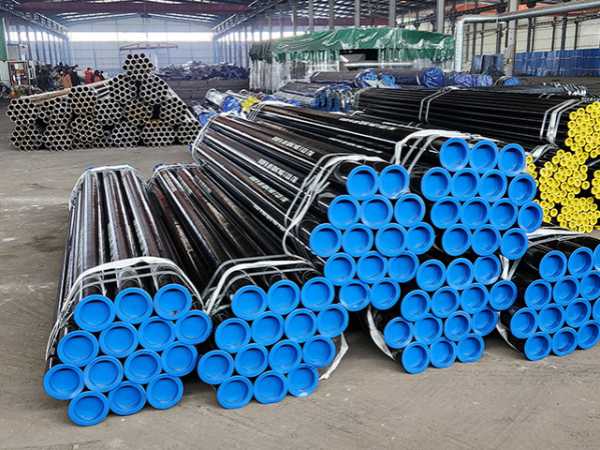
What Does Seamless Pipe Thickness Mean?
Seamless pipe thickness refers to the wall thickness (t) of the pipe, defined as half the difference between the outer diameter (OD) and inner diameter (ID):
t = (OD − ID) ÷ 2
Because seamless pipes are produced from solid billets through piercing, rolling, or drawing—rather than welding steel plates—the uniformity and consistency of wall thickness are key indicators of product quality and structural reliability.
Methods for Measuring Seamless Pipe Thickness
1. Ultrasonic Thickness Measurement
A widely used non-destructive testing (NDT) method. By analyzing ultrasonic wave travel time through the pipe wall, it enables rapid and accurate measurement of wall thickness and uniformity along the pipe length.
2. Caliper and Micrometer Measurement
Direct measurement using precision instruments, typically applied at pipe ends or sample sections. This method is accurate but limited to spot inspection.
3. Weight-Based Calculation
By measuring pipe length, outer diameter, and total weight—and using known steel density—the average wall thickness can be calculated. This serves as an effective auxiliary verification method.
Seamless Pipe Thickness by Manufacturing Process
Hot-Rolled Seamless Pipes
Outer diameter: ≥ 32 mm
Wall thickness: Approximately 2.5 mm to 75 mm
Hot rolling at high temperatures allows significant plastic deformation, resulting in pipes with thick walls, good dimensional stability, and strong mechanical properties, ideal for high-pressure applications.
Cold-Rolled / Cold-Drawn Seamless Pipes
Minimum outer diameter: As small as 6 mm
Minimum wall thickness: Approximately 0.25 mm
Cold processing improves dimensional accuracy and surface finish, making thin-walled seamless pipes suitable for precision applications where tight tolerances are required.
Seamless Pipe Thickness Tolerance
Thickness tolerance defines the permissible deviation between actual wall thickness and nominal thickness. It is a key quality criterion.
Example:
For a nominal wall thickness of 10 mm, an allowable tolerance of ±10% means an acceptable range of 9–11 mm.
Common Standards for Thickness Tolerance
ASTM A106: ±12.5%
ASTM A53: ±12.5%
ASTM A179: ±10%
ASTM A192: ±12.5%
EN 10216-2: ±10%
EN 10297-1: ±10% (or by agreement)
GB/T 8162: ±12.5%
GB/T 8163: ±12.5%
GB 5310: ±10% or stricter
Seamless Pipe Thickness Chart
|
Nominal Diameter (DN) |
Outer Diameter (mm) |
Standard Wall Thickness (mm) |
Wall Thickness Tolerance (mm) |
|
15 |
21.3 |
2.8 |
±0.4 |
|
20 |
26.9 |
2.8 |
±0.4 |
|
25 |
33.7 |
3.2 |
±0.4 |
|
32 |
42.4 |
3.5 |
±0.5 |
|
40 |
48.3 |
3.5 |
±0.5 |
|
50 |
60.3 |
3.8 |
±0.5 |
|
65 |
76.1 |
4.0 |
±0.6 |
|
80 |
88.9 |
4.0 |
±0.6 |
|
100 |
114.3 |
4.5 |
±0.7 |
|
125 |
139.7 |
4.5 |
±0.7 |
|
150 |
168.3 |
5.0 |
±0.8 |
|
200 |
219.1 |
6.0 |
±1.0 |
|
250 |
273.0 |
7.0 |
±1.1 |
|
300 |
323.9 |
8.0 |
±1.2 |
Actual tolerances are subject to specific standards (ASTM A106 / EN 10216 / GB 8162, etc.).
Thickness Comparison with Other Pipe Materials
Seamless Pipe vs Welded Pipe
Seamless pipes generally provide better wall thickness uniformity and consistent circumferential properties. Welded pipes may show localized variations near the weld seam, which can become stress concentration points under pressure, bending, or fatigue loading.
Seamless Pipe vs Cast Pipe
Cast pipes typically have lower structural density. To achieve the same pressure resistance, they often require thicker walls and higher weight, whereas seamless pipes achieve equivalent strength with better material efficiency.
Seamless Pipe vs Solid Round Bar
For bending or torsional loads, hollow seamless pipes with optimized wall thickness provide significant weight and material savings compared to solid bars, demonstrating the efficiency of hollow structural design.
Seamless Pipe vs Plastic or Composite Pipe
Plastic and composite pipes offer corrosion resistance and low weight but have much lower stiffness and temperature resistance. In high-pressure or high-temperature environments, seamless steel pipes outperform non-metallic alternatives even with thinner walls.
Impact of Thickness on Seamless Pipe Performance
Pressure Capacity
Thicker walls allow higher internal or external pressure resistance under the same material and outer diameter.
Structural Strength and Stability
Increased thickness raises section moment of inertia, improving resistance to bending, buckling, and deformation.
Weight and Cost
Greater thickness increases material usage, pipe weight, and overall cost.
Fluid Flow Performance
With a fixed OD, thicker walls reduce inner diameter, potentially increasing flow resistance and energy consumption.
Manufacturing Constraints
Hot rolling favors thick-walled pipes, while cold drawing is better suited for thin-walled, high-precision products. Extreme thicknesses may exceed process limits.
Applications of Seamless Pipes by Thickness Category
- Thin-Walled Seamless Pipes
Used where low weight and high precision are required and pressure is moderate.
Examples: automotive brake lines, fuel lines, precision hydraulic tubing, furniture structures.
- Medium-Thick-Walled Seamless Pipes
The most widely used category.
Examples: oil and gas pipelines, hydraulic cylinders, shipbuilding pipes, pressure vessels.
- Thick-Walled and Ultra-Thick-Walled Seamless Pipes
Designed for extreme pressure and temperature conditions.
Examples: boiler steam pipelines, petrochemical reactors, deep-sea drilling pipes, heavy machinery bearing sleeves.
FAQ:
Q1: Does thicker always mean stronger for seamless pipes?
Not always. Strength depends on thickness, material grade, diameter, and load type. Over-thick designs may increase cost without proportional benefit.
Q2: How is nominal wall thickness determined in standards?
It is specified based on pressure design formulas, safety factors, and applicable standards such as ASTM, EN, or GB.
Q3: Can thickness vary along the length of a seamless pipe?
Minor variation is allowed within tolerance limits, but high-quality seamless pipes maintain good uniformity.
Q4: Why is thickness tolerance critical for pressure pipelines?
Excessive negative deviation reduces pressure capacity and safety margin.
Q5: Which process is better for ultra-thin seamless pipes?
Cold-drawn or cold-rolled processes are preferred for producing ultra-thin, high-precision seamless pipes.

United Steel Industry As the most important steel pipe manufacturer and exporter in China, in the past 20 years, we have completed more than 100 projects, with partners in more than 100 countries, and established relationships with oil and gas and EPC companies in many countries business relationship.
For more information about the product price, catalog and rolling mill inspection certificate,
please consult:Email:Sales@usisteels.com