Choosing between square hollow sections (SHS) and circular hollow sections (CHS) is a common challenge in construction, machinery manufacturing, and infrastructure projects.
An incorrect choice may lead to higher costs, structural inefficiency, installation difficulties, or safety risks.
This guide provides a clear selection framework to help you decide quickly and professionally based on real engineering scenarios.
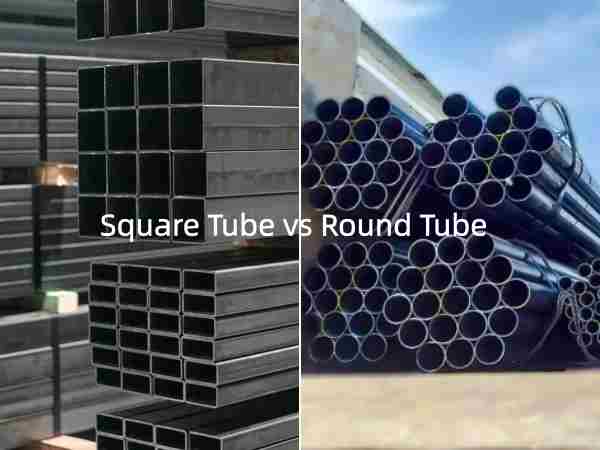
Typical Selection Dilemmas Explained
Steel structures: Which is stronger and more economical—square or round tubes?
Fluid pipelines: Why are square tubes rarely used?
Equipment racks: How to balance load capacity and ease of installation?
Architectural design: Which tube offers better aesthetics without compromising strength?
By understanding the geometry-driven performance differences, you can avoid common mistakes and make the optimal choice.
Mechanical Property Differences: SHS vs CHS
1. Compressive Strength
Round Tubes (CHS)
Circular cross-section distributes compressive stress uniformly along the circumference
Excellent resistance to axial compression
Lower risk of local buckling
Ideal for columns, supports, and load-bearing members
Square Tubes (SHS)
Corners act as stress concentration zones
More susceptible to local deformation under axial load
Perform well when load is applied directionally and predictably
Engineering Insight:
For pure compression or variable load directions, round tubes outperform square tubes.
2. Bending Strength
Round Tubes (CHS)
Uniform moment of inertia in all directions
Equal bending resistance regardless of load orientation
Suitable for torsion and multi-directional bending
Square Tubes (SHS)
Directional bending resistance
Stronger bending capacity along flat sides
Requires correct orientation during design
Engineering Insight:
Square tubes are efficient when the load direction is known and fixed.
Fluid Dynamics Performance Differences: Square Tube vs Round Tube
1. Fluid Transport Efficiency
Round Tubes (CHS)
Smooth inner wall with no sharp corners
Minimal flow resistance
Lower energy loss
Standard choice for water, gas, oil, and chemical pipelines
Square Tubes (SHS)
Sharp internal corners generate turbulence
Higher pressure drop
Increased energy consumption
Conclusion:
Square tubes are not suitable for fluid transport systems.
2. Self-Cleaning Ability
Round tubes allow continuous flushing of impurities
Square tube corners trap deposits, increasing blockage risk
Result:
CHS offers superior hygiene and long-term flow stability.
Connection & Installation Performance Differences: Square Tube vs Round Tube
1. Connection Methods
Round Tubes
Welding
Threaded connections
Flange connections
Easier to standardize and control quality
Square Tubes
Primarily welded connections
Corners require additional machining for non-welded joints
2. Connection Strength & Fatigue Resistance
Round tubes distribute stress evenly at joints
Better fatigue performance under cyclic loading
Square tubes experience higher stress concentration at corners
Appearance & Space Utilization
1. Aesthetic Considerations
Round Tubes
Smooth, modern, and fluid appearance
Common in stadiums, exhibition halls, and modern architecture
Square Tubes
Clean, rigid, and industrial look
Suitable for frames, racks, and modular structures
2. Space Utilization Efficiency
Square Tubes
Stack and align efficiently
Higher space utilization
Ideal for shelving, frames, and compact layouts
Round Tubes
Gaps between pipes reduce packing efficiency
Final Decision Guide: SHS or CHS?
|
Application Requirement |
Recommended Tube |
|
Fluid transport |
Round tube (CHS) |
|
High pressure systems |
Round tube (CHS) |
|
Torsion or multi-directional loads |
Round tube (CHS) |
|
Structural frames with fixed load direction |
Square tube (SHS) |
|
Equipment racks & shelving |
Square tube (SHS) |
|
Maximum space utilization |
Square tube (SHS) |
|
Modern architectural design |
Round tube (CHS) |
Conclusion: Geometry Determines Performance
Square tubing (SHS) is the optimal choice when bending resistance, flat surfaces, and space efficiency are critical.
Round tubing (CHS) is the only correct solution for fluid transport, high pressure, torsion, and fatigue-sensitive applications.
The fundamental difference lies in the absolute influence of cross-sectional geometry on mechanical behavior.
FAQ
Q1: Why are round tubes preferred for pipelines?
A: Because they offer lower flow resistance, better self-cleaning ability, and uniform pressure distribution.
Q2: Are square tubes stronger than round tubes?
A: Square tubes are stronger in directional bending, while round tubes are stronger under compression and torsion.
Q3: Can square tubes be used for fluid transport?
A: Generally no, due to higher flow resistance and poor self-cleaning performance.
Q4: Which tube is better for equipment frames?
A: Square tubes, due to flat surfaces and higher space utilization efficiency.
Q5: What determines the core difference between SHS and CHS?
A: Cross-sectional geometry, which directly controls stress distribution and mechanical performance.

United Steel Industry As the most important steel pipe manufacturer and exporter in China, in the past 20 years, we have completed more than 100 projects, with partners in more than 100 countries, and established relationships with oil and gas and EPC companies in many countries business relationship.
For more information about the product price, catalog and rolling mill inspection certificate,
please consult:Email:Sales@usisteels.com