Spiral Submerged Arc Welded (SSAW) steel pipes are widely used in oil & gas, water transmission, and structural engineering projects due to their ability to support large diameters and medium-to-thick wall designs. Pipe size is typically defined by outside diameter (OD) and wall thickness, making it flexible for different pressure and flow requirements.
The common SSAW steel pipe size range is:
Outer diameter: 406 mm – 2540 mm (16" – 100")
Wall thickness: 6 mm – 25.4 mm (can be higher for customization)
Custom dimensions are available for specific engineering requirements.
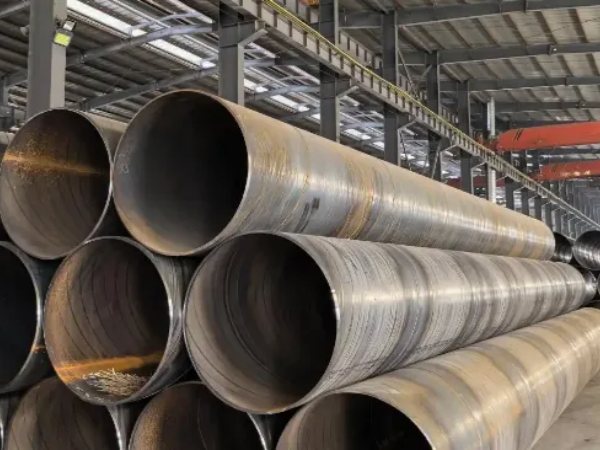
This range is widely used in municipal and standard industrial systems.
Typical applications:
Urban water supply and drainage
Low to medium-pressure oil and gas pipelines
General infrastructure projects
Size overview:
16"–20" (406–508 mm): Small municipal pipelines, easy installation
24"–36" (610–914 mm): Medium-pressure transmission and structural use
This range balances cost, handling efficiency, and mechanical strength.
Large-diameter SSAW pipes are designed for high-capacity fluid transport and heavy engineering structures.
Typical applications:
Long-distance oil and gas transmission
Large water diversion projects
Offshore and structural foundations
Size overview:
40"–60" (1016–1524 mm): High-flow pipelines and trunk lines
72"–100" (1820–2540 mm): Ultra-large custom projects and offshore structures
These pipes are usually project-specific and fully customized.
|
OD (mm) |
Inch |
Wall Thickness (mm) |
Steel Grades |
|
219.1 |
8" |
6.0–10.0 |
Q235B, Q345B, L290(X42) |
|
406.4 |
16" |
6.0–16.0 |
Q235B, Q345B, L290–L360 |
|
610.0 |
24" |
6.0–25.4 |
Q235B, Q345B, L290–L415 |
|
813.0 |
32" |
8.0–25.4 |
Q235B, Q345B, L290–L450 |
|
1016.0 |
40" |
9.0–25.4 |
Q235B, Q345B, X42–X65 |
|
1422.0 |
56" |
10.0–30.0 |
Q235B, Q345B |
|
1820.0 |
72" |
12.0–30.0 |
Q235B, Q345B |
|
2540.0 |
100" |
16.0–35.0 |
Q235B, Q345B |
1. Flow Rate Requirement
Larger diameters provide higher flow capacity but increase material cost and installation space requirements.
2. Operating Pressure
Higher pressure systems require thicker wall designs to ensure structural safety.
3. Application Type
Fluid transport focuses on pressure resistance and flow efficiency
Structural use focuses on stiffness and load-bearing performance
4. Project Cost
Pipe diameter and wall thickness directly affect material cost. In large projects, lifecycle cost (energy + maintenance) is more important than initial price.
Oil & Gas Transmission
SSAW pipes are widely used in long-distance pipelines due to high strength and compatibility with anti-corrosion coatings such as 3PE.
Water Supply & Drainage
Used in urban water systems and diversion projects, offering smooth flow and strong external pressure resistance.
Structural Engineering
Applied in bridge piles, building foundations, and offshore platforms due to high load-bearing capacity.
Industrial Applications
Used in mining slurry pipelines, power plant water systems, and general industrial transport lines.
ERW pipes: Suitable for small diameters (typically ≤24"), with high precision and lower cost
SSAW pipes: Suitable for large diameters and medium-thick walls with high flexibility
General selection rule:
≤24" → ERW preferred
24"→SSAW preferred
SSAW pipes are not ideal in some conditions:
High-pressure gas transmission (often LSAW is preferred)
Small-diameter pipelines (<16")
Highly corrosive environments without proper internal/external coating
1. What is the standard size range of SSAW steel pipes?
SSAW pipes typically range from 406 mm to 2540 mm in outer diameter.
2. What is the most commonly used SSAW pipe size?
Sizes between 24" and 60" are most commonly used in industrial and pipeline projects.
3. Can SSAW pipes be customized?
Yes, SSAW pipes support customized diameter, wall thickness, and steel grades.
4. What is the main advantage of SSAW pipes?
They are suitable for large-diameter pipelines with flexible size and cost efficiency.
5. Where are SSAW steel pipes mainly used?
They are widely used in oil & gas, water transmission, structural foundations, and industrial systems.

United Steel Industry As the most important steel pipe manufacturer and exporter in China, in the past 20 years, we have completed more than 100 projects, with partners in more than 100 countries, and established relationships with oil and gas and EPC companies in many countries business relationship.
For more information about the product price, catalog and rolling mill inspection certificate,
please consult:Email:Sales@usisteels.com