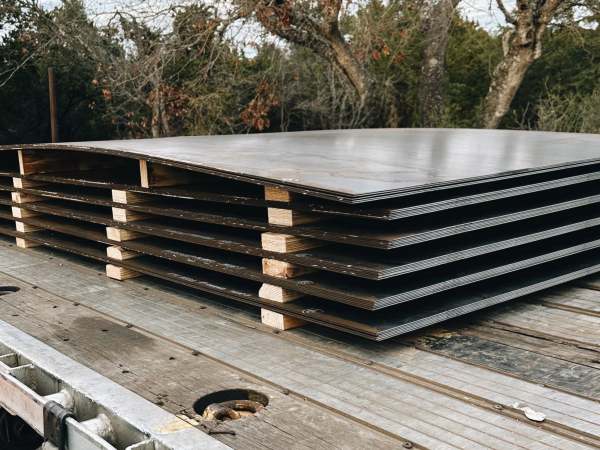
Mild steel plates are widely used in construction, fabrication, manufacturing, and general engineering due to their balanced combination of strength, cost efficiency, and ease of processing. They serve as a fundamental material in both structural and non-structural applications where reliable performance and manufacturability are required.
A mild steel plate is a flat rolled steel product manufactured from low-carbon steel. The reduced carbon content improves ductility, making the material easier to cut, weld, drill, and form.
Mild steel plates typically offer a tensile strength of 370–440 MPa, enabling them to withstand moderate to heavy structural loads without failure.
This makes them suitable for everyday engineering applications where extreme alloy performance is not required.
The yield strength generally ranges between 250–350 MPa.
This allows the material to resist permanent deformation under stress, improving structural safety and reliability.
High ductility allows easy bending, rolling, pressing, and shaping without cracking.
This is particularly valuable in custom fabrication, structural manufacturing, and heavy equipment production.
Due to low carbon content, mild steel plates exhibit excellent weldability.
They are compatible with:
MIG welding
TIG welding
Arc welding
Proper welding procedures ensure strong and consistent joints.
Mild steel can be efficiently:
Drilled
Cut
Milled
Machined
This supports high fabrication efficiency in workshops and industrial manufacturing facilities.
One of the key advantages is low material cost. Mild steel plates offer a strong performance-to-price ratio, making them ideal for large-scale and budget-sensitive projects.
Mild steel has limited natural corrosion resistance. However, durability can be significantly improved through:
Galvanization
Painting
Epoxy coating
These treatments extend service life in outdoor and humid environments.
Mild steel plates are widely available globally and commonly produced under international standards such as:
ASTM A36
EN 10025 S235JR
These standards ensure predictable mechanical performance and interchangeability across projects.
|
Property |
Typical Range |
Key Advantage |
|
Tensile Strength |
370–440 MPa |
Load-bearing capability |
|
Yield Strength |
250–350 MPa |
Structural stability |
|
Ductility |
High |
Easy forming and bending |
|
Weldability |
Excellent |
Strong joint performance |
|
Machinability |
Good |
Efficient fabrication |
|
Cost |
Low |
Economical for large projects |
Mild steel plates are used in:
Structural steel fabrication
Building and bridge construction
Pressure vessels and storage tanks
Heavy machinery manufacturing
Shipbuilding and offshore structures
General industrial fabrication
Their adaptability makes them suitable for both light-duty and heavy-duty engineering environments.
1. Why are mild steel plates widely used?
Because they combine affordability, strength, and easy fabrication, making them suitable for a broad range of industrial and structural applications.
2. Can mild steel plates be welded easily?
Yes. Their low carbon content supports most standard welding processes and provides excellent weldability.
3. Are mild steel plates suitable for outdoor use?
Yes, but only when protected with coatings such as galvanizing, painting, or epoxy systems to prevent corrosion.
4. What is the difference between ASTM A36 and S235JR?
They are widely used structural steel grades produced under different regional standards, with similar mechanical properties and engineering applications.
Mild steel plates are ideal when you need:
Good strength performance
Easy fabrication and welding
Cost-effective structural material
Wide availability in multiple thicknesses and dimensions
However, for aggressive environments such as seawater exposure, chemical corrosion, or extreme abrasion, stainless steel plates or alloy steel plates should be considered instead.

United Steel Industry As the most important steel pipe manufacturer and exporter in China, in the past 20 years, we have completed more than 100 projects, with partners in more than 100 countries, and established relationships with oil and gas and EPC companies in many countries business relationship.
For more information about the product price, catalog and rolling mill inspection certificate,
please consult:Email:Sales@usisteels.com