The quality tracking of L245M straight seam welded steel pipes depends on a complete traceability system, including heat number tracking, batch identification, chemical analysis, mechanical testing, and full-process documentation. These measures ensure compliance with pipeline standards and long-term service reliability.
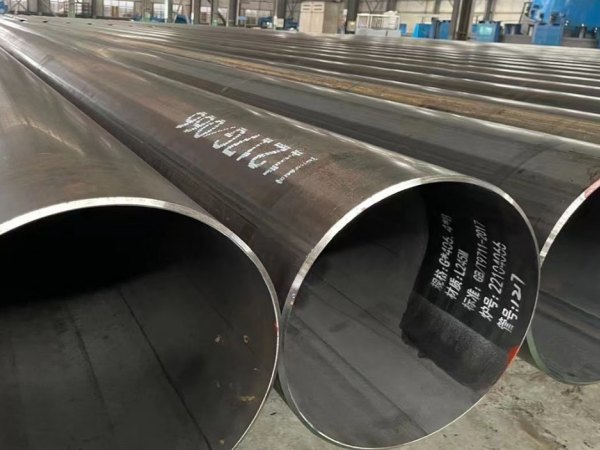
L245M is a commonly used pipeline steel grade for oil and gas transportation.
Outer Diameter: 76 mm–1420 mm
Wall Thickness: 3 mm–80 mm
GB/T 9711 (PSL1 / PSL2)
Oil & gas pipeline transportation systems
SAW (Double-Sided Submerged Arc Welding)
HFW (High-Frequency Welded Pipe)
C≤0.22%
Si≤0.50%
Mn≤1.20%
P≤0.025%
S≤0.015%
V≤0.05%
Nb≤0.05%
Ti≤0.04%
Yield Strength:≥245 MPa
Tensile Strength: 415–655 MPa
Yield Ratio:≤0.93
These parameters ensure adequate strength, weldability, and pipeline safety performance.
To guarantee consistent quality, manufacturers must establish a full-process traceability system. Key factors include:
Each pipe must be linked to its original steelmaking heat number
Traceability is maintained until chemical composition testing is completed and verified
Purpose:
Ensure material origin and chemical compliance
Pipes are grouped into test batches for mechanical testing
Includes tensile, yield, and other required tests
Requirement:
Traceability must be maintained until all test results meet standard specifications
Manufacturers must document:
Furnace number
Production parameters
Processing conditions
Function:
Enable full lifecycle traceability from raw material to finished pipe
A complete system should allow:
From any single pipe, trace back to:
Heat number
Chemical composition report
Mechanical test results
Production batch
This is critical for:
Quality audits
Project certification
Failure analysis
In pipeline applications, L245M steel pipes operate under:
High pressure
Corrosive environments
Long-distance transportation conditions
Without traceability:
Defect sources cannot be identified
Maintenance costs increase
Safety risks rise
A robust traceability system ensures:
Consistent product quality
Compliance with international standards
Reliable long-term pipeline operation
L245M straight seam welded steel pipes are widely used in:
Energy Infrastructure
Oil pipelines
Natural gas transmission systems
Urban pipeline networks
Industrial & Mining
Mine water pipelines
Coal slurry transportation
Structural Engineering
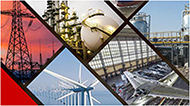
High-voltage transmission structures
Wind power projects
Bridges and high-speed railway structures
Quality tracking of L245M straight seam welded steel pipes is not a single test, but a systematic process covering material, production, and inspection stages.
The key lies in:
“Full traceability + standardized testing + documented control”
This ensures that every pipe delivered meets strict performance and safety requirements in critical applications.
Q1: What is the key to L245M pipe quality tracking?
A: A complete traceability system from raw material to finished pipe.
Q2: What is a heat number?
A: It identifies the steelmaking batch for chemical traceability.
Q3: Why is batch testing important?
A: It ensures mechanical properties meet standards.
Q4: Can one pipe be traced individually?
A: Yes, via batch, heat number, and test records.
Q5: Where are L245M pipes mainly used?
A: Oil, gas, and infrastructure pipelines.

United Steel Industry As the most important steel pipe manufacturer and exporter in China, in the past 20 years, we have completed more than 100 projects, with partners in more than 100 countries, and established relationships with oil and gas and EPC companies in many countries business relationship.
For more information about the product price, catalog and rolling mill inspection certificate,
please consult:Email:Sales@usisteels.com