Seamless steel pipes fail hydrostatic tests mainly due to material defects, manufacturing issues, dimensional inconsistencies, or improper testing procedures. Failures typically appear as leakage or bursting under pressure. Controlling raw material quality, optimizing production processes, and standardizing testing operations are key to improving hydrostatic test pass rates.
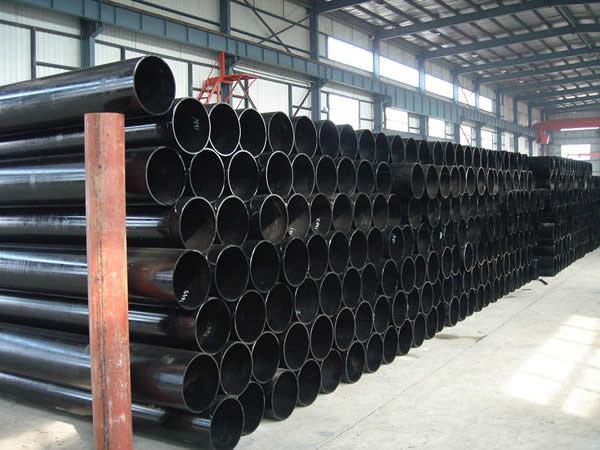
A hydrostatic test evaluates the pressure resistance and sealing performance of seamless steel pipes by filling them with water and applying internal pressure (typically 1.25–1.5× design pressure).
Failure modes:
Leakage (micro-defects or sealing issues)
Bursting/cracking (structural weakness)
Defects originating from steel billets are the most critical and often irreversible.
Typical issues:
Surface cracks → propagate during rolling
Non-metallic inclusions → act as crack initiation points
Segregation (centerline or carbon segregation) → uneven mechanical properties
These defects reduce the pipe’s inherent pressure resistance.
Improper processing during pipe forming directly affects structural integrity.
Common problems:
Surface scratches or folds → reduce effective wall thickness
Internal folds → create stress concentration points
Uneven wall thickness → weakest section fails under pressure
Improper heat treatment → coarse grains, low yield strength
These are major causes of bursting during hydrostatic testing.
Final-stage defects or missed inspections can allow defective pipes to pass factory checks.
Key risks:
Poor thread machining → stress concentration at pipe ends
Missed non-destructive testing (UT/ET) → hidden defects undetected
Incomplete quality control → defective pipes enter testing stage
For installed pipelines, failure may not originate from the pipe body.
Typical causes:
Joint leakage (poor welding or sealing)
Improper gasket installation
Ground settlement causing joint stress or cracking
Incomplete air removal → unstable pressure readings
Incorrect testing procedures can lead to false failures or actual damage.
Common issues:
Pump malfunction → insufficient or unstable pressure
Uncalibrated pressure gauges → inaccurate readings
Insufficient pressure holding time → misleading pressure drop
Air trapped inside pipe → pressure fluctuation
Transport damage → micro-cracks or impact defects
Improper storage → corrosion or surface damage
Excessive test pressure → exceeding allowable limits
Over-pressurization (especially >1.5–2× design pressure) can directly cause rupture.
Use high-quality billets with low inclusion levels
Strict inspection during continuous casting
Control rolling parameters to avoid folds and thinning
Apply proper heat treatment (normalizing, quenching & tempering)
Ensure dimensional accuracy
Perform ultrasonic or eddy current testing (100% coverage)
Inspect pipe ends and threads carefully
Reject defective pipes before hydrostatic testing
Test pressure: 1.25–1.5× design pressure
Holding time: ≥10 minutes
Ensure complete air removal
Use calibrated pressure gauges
Avoid mechanical damage during transport
Store in dry, protected environments
Hydrostatic test failures in seamless steel pipes are primarily caused by material defects, manufacturing issues, and improper testing practices. By implementing strict quality control across raw materials, production, inspection, and testing stages, manufacturers can significantly improve reliability and ensure compliance with industry standards.
1. What is the most common cause of hydrostatic test failure?
Material defects such as inclusions, cracks, and wall thickness inconsistencies are the primary causes.
2. Does heat treatment affect hydrostatic test results?
Yes. Improper heat treatment can reduce strength and lead to failure under pressure.
3. Can testing errors cause failure?
Yes. Incorrect pressure, trapped air, or faulty equipment can lead to inaccurate or failed results.
4. What pressure is used in hydrostatic testing?
Typically 1.25 to 1.5 times the design working pressure.
5. Can defective pipes pass non-destructive testing but fail hydro tests?
Yes. If NDT is incomplete or defects are subtle, they may only be revealed under pressure testing.

United Steel Industry As the most important steel pipe manufacturer and exporter in China, in the past 20 years, we have completed more than 100 projects, with partners in more than 100 countries, and established relationships with oil and gas and EPC companies in many countries business relationship.
For more information about the product price, catalog and rolling mill inspection certificate,
please consult:Email:Sales@usisteels.com